What Happens After I Get Genetic Nutrition Testing?
Most people spend weeks deciding whether to get genetic testing done. Then the report arrives, and nobody told them what to do next.
This is the gap nobody in this industry talks about. The testing companies give you data. The functional medicine world gives you supplements. And the wellness industry gives you content about what foods are good for your variants.
Nobody shows you how to cook for them.
Here is exactly what happens after your genetic nutrition testing, and what it actually takes to turn that report into a plate of food that works for your biology.
The short answer: After genetic nutrition testing, the next step is interpretation, translating your variants into a practical food strategy. That means understanding which genetic markers affect how you absorb nutrients, how your body processes macronutrients, and where your inflammatory risk sits. Then it means building a meal plan around those findings and learning to cook for them. The report is the starting line, not the finish.
Step One: You Get a Report You Probably Cannot Read
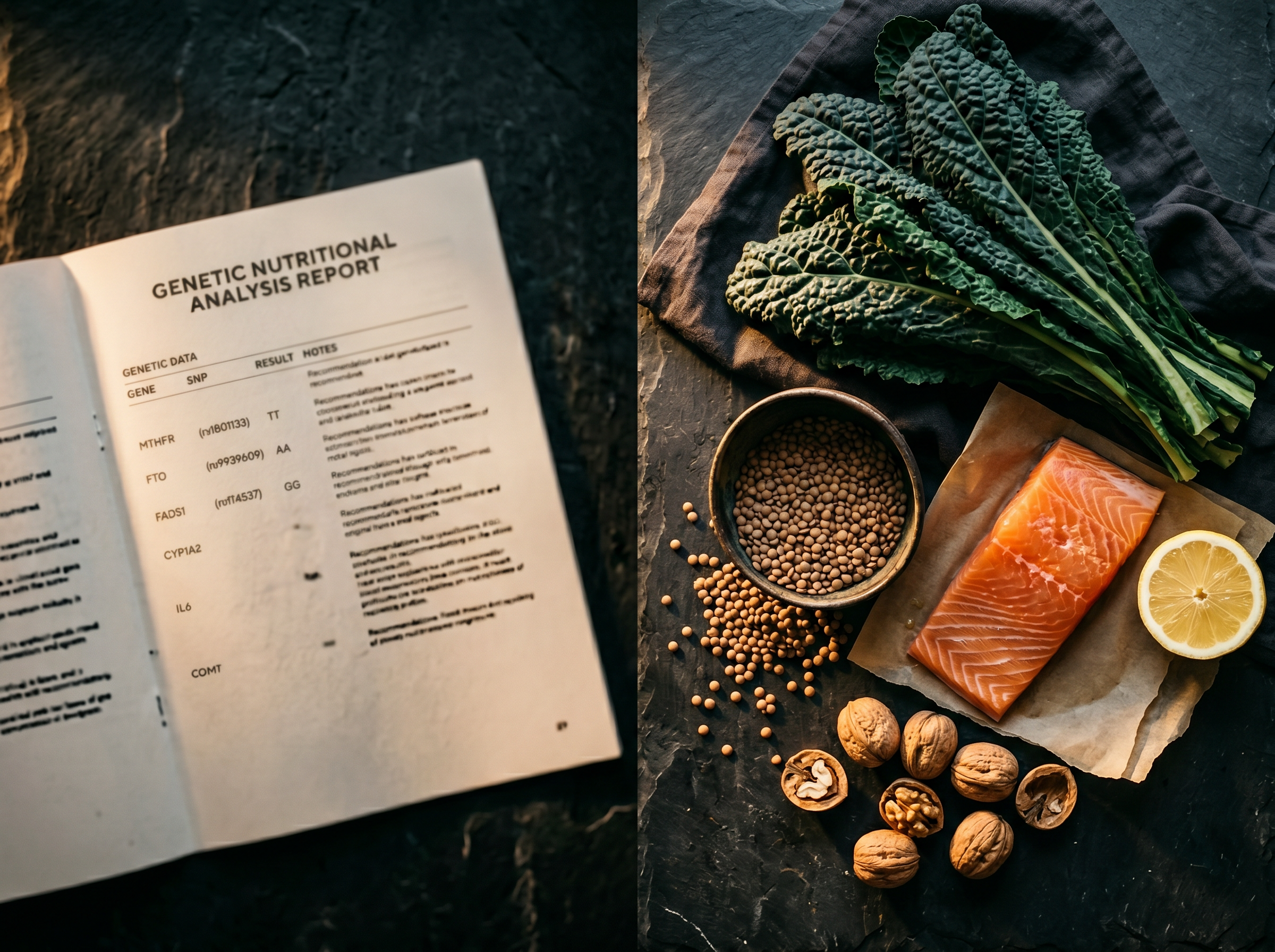
Most genetic nutrition reports run 20 to 60 pages. They include SNP (single nucleotide polymorphism) identifiers, variant classifications like homozygous and heterozygous, and terms like MTHFR, COMT, VDR, and FADS1.
If you are not a geneticist, this reads like a foreign language.
The report will tell you things like:
- Your MTHFR C677T variant suggests reduced methylation capacity
- Your FTO gene variant is associated with increased fat mass sensitivity
- Your FADS1 variant may affect conversion of omega-3 fatty acids
What it will not tell you is what to put in the pan tonight.
That is not a flaw in the testing, it is a flaw in the system. Testing companies are not chefs. Most practitioners who interpret these reports are not chefs either. They can tell you what your body needs. They cannot show you how to get it onto a plate in a form your body can actually absorb.
“Your genes are not your destiny. They are your ingredients list. The question is who is doing the cooking.”
Step Two: Interpretation, What Your Variants Actually Mean
Before a single meal plan gets built, your variants need to be translated into plain language. Not clinical language. Not supplement-label language. Cooking language.
Here is what that looks like for three of the most common variants:
MTHFR, The Methylation Variant
MTHFR affects your body's ability to convert folate from food into the active form it can use. If you carry this variant, standard folate from enriched flour and most supplements is largely wasted. Your body cannot process it efficiently.
What this means in the kitchen: You need food-form folate from sources like dark leafy greens, lentils, and liver, prepared in ways that preserve the folate content. High heat destroys it. Short cooking times and raw preparations matter.
This is not information you get from a report. This is culinary knowledge applied to genetic data.
FTO, The Weight and Satiety Variant
FTO variants are associated with how your brain receives satiety signals. People with certain FTO variants tend to feel less full after eating, which drives overconsumption, not from lack of willpower, but from a genetic difference in how hunger hormones communicate.
What this means in the kitchen: Meal composition matters more than calorie counting. Fat and protein ratios, meal timing, and specific satiety-promoting foods like resistant starches and fermented proteins can work with your FTO profile rather than against it.
FADS1 and FADS2, Omega-3 Conversion
These variants affect how efficiently your body converts plant-based ALA (found in flaxseed, walnuts, chia) into the EPA and DHA your brain and cardiovascular system actually use. If your conversion rate is low, eating flaxseed is not enough. You need pre-formed EPA and DHA from marine sources.
What this means in the kitchen: Wild salmon, sardines, mackerel, and pasture-raised eggs become non-negotiable. How you cook them matters too, oxidized fats from high-heat cooking reduce bioavailability.
Step Three: Building Your Genetic Meal Plan
Once your key variants are interpreted, the meal plan builds from them, not from a general healthy eating template with your name on it.
A true genetic meal plan does several things that a standard meal plan does not:
- It prioritizes bioavailable forms of the nutrients your variants most affect
- It accounts for your inflammatory genetics and adjusts cooking methods accordingly
- It considers your macronutrient metabolism, how efficiently you process carbohydrates, fats, and proteins
- It incorporates your detoxification genetics, which affect how your body clears environmental compounds from food
- It is designed around cooking techniques that maximize absorption, not just nutrient presence
That last point is where most genetic nutrition services stop short. A food can contain a nutrient and still fail to deliver it if it is not prepared correctly. Turmeric without fat and black pepper. Spinach oxalates binding calcium. Cruciferous vegetables and thyroid genetics. Every preparation decision is a nutritional decision.
“Science tells you what your body needs. Culinary mastery delivers it.”
Step Four: Learning to Cook for Your Biology
The meal plan is a document. Your kitchen is where it either works or does not.
This is the stage most genetic nutrition practitioners skip entirely, because most of them are not chefs. They hand you a plan and expect you to execute it. If you already know how to cook at the level the plan requires, that might work. Most people do not.
Cooking for your genetics is a specific skill set. It includes:
- Knowing which cooking methods preserve the nutrients your variants most need
- Understanding how heat, acid, fat, and time affect bioavailability of specific compounds
- Sourcing ingredients that meet the quality standards your genetic profile demands
- Building meals with the right macro ratios for your metabolic architecture
- Recognizing when a substitution preserves the genetic intent of a recipe and when it undermines it
This is what a private performance nutrition chef does that no app, algorithm, or report can replicate. The translation from data to plate requires both the science and the culinary execution, together, in the same room, at the same time.
Step Five: Tracking What Actually Changes
Genetic variants are not diagnoses. They are tendencies. How strongly a variant expresses depends on what you eat, how you sleep, how you move, and what your environment exposes you to.
After implementing a genetic meal plan, the markers worth watching include:
- Energy levels across the day, particularly in the afternoon window where metabolic stalls are most common
- Inflammatory symptoms, joint stiffness, brain fog, skin reactivity, and digestive irregularity
- Recovery quality after physical exertion
- Sleep architecture, not just duration but depth and morning cognitive clarity
- Relevant lab values at your next blood panel, CRP, homocysteine, vitamin D, ferritin, and omega-3 index are the most informative
These are not promises. They are data points. Genetic nutrition is not a cure and it is not a guarantee. It is a precision tool. The more accurately it is implemented, the more clearly you can track its effects.
What Most People Get Wrong About Genetic Nutrition Testing
The biggest misconception is that the test is the intervention. It is not. The test is the map. Getting the map does not move you anywhere.
The second misconception is that interpretation is enough. You can understand what your variants mean and still eat in ways that work against them, because you do not know how to cook for them.
The third misconception is that this is a one-time event. Your genes do not change. But your life does. A meal plan built for a 38-year-old endurance athlete looks different than one built for the same person at 45 managing an autoimmune condition. The genetic foundation stays constant. The application evolves.
“Optimal health is not a destination. It is what happens when you stop eating against yourself.”
Frequently Asked Questions
How long does it take to see results from genetic nutrition testing?
Most clients notice shifts in energy and digestion within 4 to 6 weeks of consistent implementation. Lab-level changes, homocysteine, CRP, vitamin D, typically appear within 3 to 6 months. The timeline depends on how significantly your previous diet was working against your genetics and how precisely the new protocol is executed.
Do I need a chef to implement genetic nutrition?
You need someone who can translate the genetic data into a cooking practice. That can be self-directed if you have strong culinary skills and a clear interpretation of your variants. Most people find the gap between understanding the report and executing a compliant meal plan is wider than expected. A private performance nutrition chef bridges both sides in a single engagement.
What genetic testing platforms do you use?
Chef Alexx works with SelfDecode and Genetic Genie for professional-grade variant analysis. Both platforms provide clinically relevant SNP data that can be mapped directly to nutrient protocols and culinary applications.
Is genetic nutrition testing the same as a DNA diet kit?
No. Consumer DNA diet kits like those sold in pharmacies provide general tendency scores. Professional genetic nutrition analysis examines specific variants with clinical significance and maps them to precise dietary and culinary interventions. The difference is similar to a home blood pressure cuff versus a cardiology workup.
What happens during a genetic nutrition consultation with Chef Alexx?
The engagement begins with your genetic report and three intake questions that reveal what no lab panel can. From there, Chef Alexx builds a culinary roadmap, not a supplement list, that identifies the specific foods, preparation methods, and meal structures your variants call for. For private chef clients, this is followed by in-home execution. For remote clients, it becomes a detailed culinary guide you can work from in your own kitchen.
Ready to Find Out What Your Report Actually Means?
Most genetic nutrition reports sit in inboxes. Opened once, never acted on.
If you have results from 23andMeAncestryDNA, SelfDecode, or any other platform and you are not sure what to do with them, that is exactly where a discovery call with Chef Alexx starts.
No sales pitch. No protocol pushed before the conversation happens. Just a clear look at where you stand and what the path forward looks like for your specific biology.
Book a discovery call:
mechanixxofhealth.com · (435) 708-1972 · chefalexx@mechanixxofhealth.com
Get the book:
Secrets of a Private Performance Nutrition Chef · mechanixxofhealth.com/book
Take the free Mechanixx Readiness Assessment:
Eight questions. Three minutes. Instant results. Find out exactly where you stand before the conversation starts.